


Contract Staffing vs Full-Time Hiring in India: A 2026 Cost Breakdown
Every hiring manager asks this at some point: should I hire this person full-time, or bring them in on contract?
The honest answer is that it depends on how long you need them, how fast you need them, and what you count as cost. This guide walks through a simple example so you can run the same math with your own numbers.
Important: every number below is an example to show the method. They are not market averages or quotes. Replace them with your own figures before you decide anything.
This article is general information, not legal, tax or financial advice. Get local advice for your situation.
The two models in one minute
Full-time hiring. The person is on your payroll. You pay salary, employer contributions and benefits. You usually pay a recruitment fee when you hire through an agency. The person has notice periods and exit costs on both sides.
Contract staffing. The person is employed by a staffing partner and works for you. You pay a monthly billing rate to the partner. The partner handles payroll, statutory contributions and compliance, and adds a margin. You can usually scale the team up or down with shorter notice.
The example we will use
An engineer with a fixed salary of Rs 12,00,000 a year (Rs 1,00,000 a month). All figures are examples.
Full-time cost, year 1
| Item | How we got it | Example amount (Rs) |
|---|---|---|
| Annual fixed salary | Given | 12,00,000 |
| Employer PF | 12% of basic, assuming basic is 40% of salary (Rs 4,80,000) | 57,600 |
| Gratuity provision | 15 days of basic for each year of service (15/26 of one month's basic) | 23,077 |
| Health insurance | Example figure | 15,000 |
| Recruitment fee | Example 10% of annual salary, paid once | 1,20,000 |
| Laptop and onboarding | Example figure, paid once | 50,000 |
| Year 1 total | 14,65,677 |
From year 2, the recruitment fee and onboarding do not repeat. Year 2 cost is 12,00,000 + 57,600 + 23,077 + 15,000 = 12,95,677.
Contract cost, per year
Assume the staffing partner pays the engineer Rs 1,00,000 a month and charges you a billing rate of Rs 1,15,000 a month. That means a 15% margin, which covers statutory contributions, benefits and the partner's own costs. The margin is an example only. Real margins vary.
| Item | Example amount (Rs) |
|---|---|
| Monthly billing rate | 1,15,000 |
| Annual cost | 13,80,000 |
There is usually no separate recruitment fee, and no gratuity or notice obligation sits on your books. Check your contract for conversion and replacement terms.
What the example shows
| Full-time | Contract | |
|---|---|---|
| Year 1 | 14,65,677 | 13,80,000 |
| Year 2 | 12,95,677 | 13,80,000 |
| Two year total | 27,61,354 | 27,60,000 |
In this example:
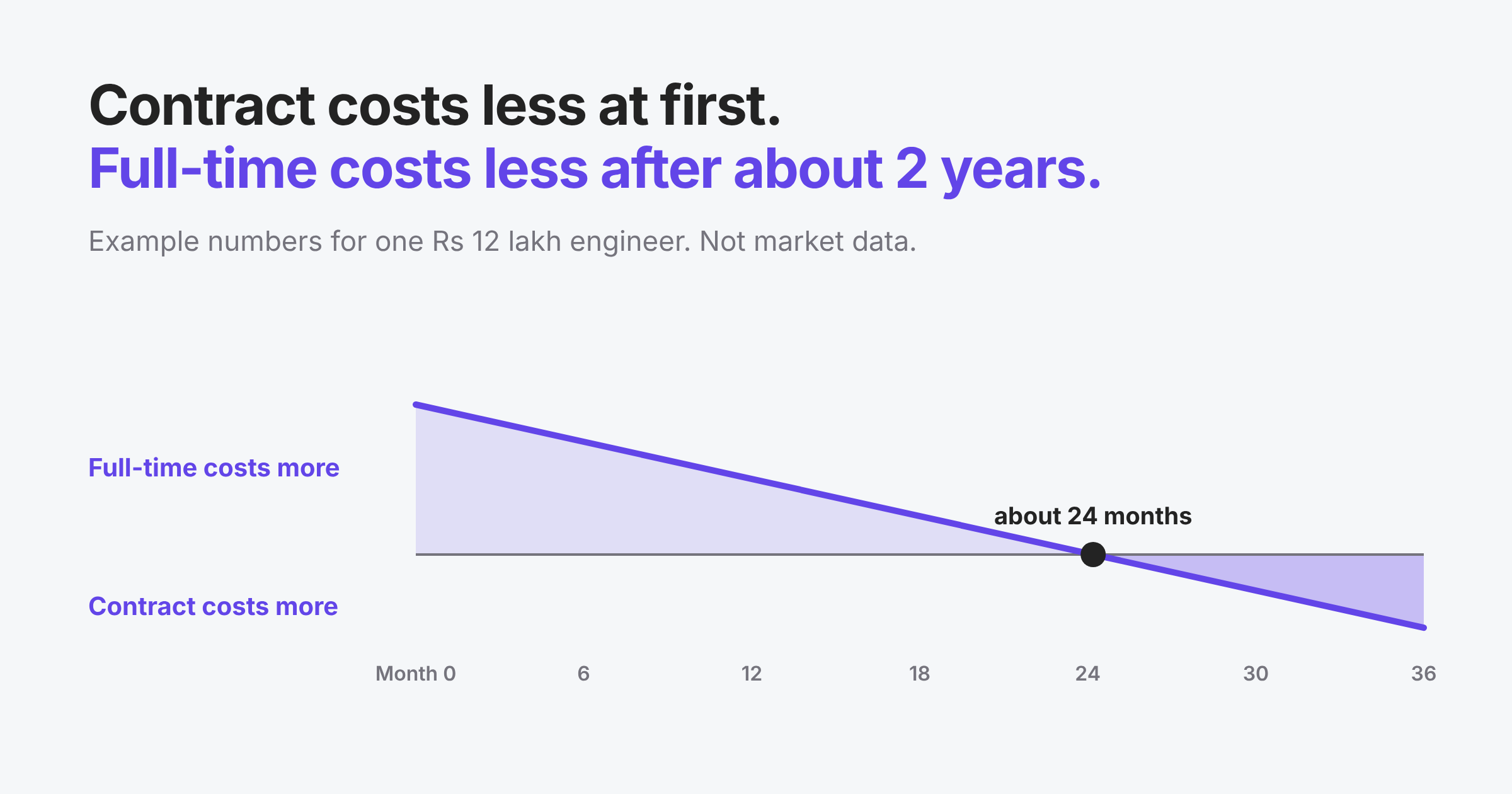
- Contract is cheaper in year 1 by about Rs 85,677, because there is no hiring fee or onboarding spend.
- Full-time is cheaper from year 2 by about Rs 84,323 a year.
- The two cost almost the same at around two years.
So under these example numbers, the longer the need, the better full-time looks. The shorter the need, the better contract looks. If your margin, fee or benefits are different, the crossover point moves. Use your own figures.
Costs people forget
For full-time:
- Time to hire and cost of an empty seat
- Notice period before the person joins
- Bonuses, leave encashment and other benefits
- Exit costs if the role ends or the person leaves
- Cost of a bad hire, including the time to replace them
For contract:
- Margin on top of salary, every month
- Knowledge that leaves when the contract ends
- Lower team ownership for some roles
- Conversion fees if you later hire the person full-time
- Compliance risk if the arrangement is set up wrongly. Get advice so the person is properly engaged and not treated as an employee in practice.
When contract tends to make sense
- The project has a clear end date
- You need to ramp up or down quickly
- You want to test a role before committing
- The skill is needed for a short period
- You are still deciding the team structure
When full-time tends to make sense
- The role is core and long term
- You want to build deep product knowledge in the team
- You need strong ownership and culture fit
- You expect the person to grow into a bigger role
- The need will last well beyond two years
A simple way to decide
- Write down how long you need the role. Under 12 months leans contract. Over 24 months leans full-time.
- Run the same table with your numbers. Salary, margin, fee, benefits.
- Add the cost of waiting. Each month a seat stays empty has a business cost. Contract is often faster to start, so count it.
- Think about risk. Ask what happens if the project is cancelled, or if the person leaves.
- Get one opinion from finance and one from legal. Treatment of contributions and engagement terms matters.
If you work with recruitment agencies
Be clear with agencies about which model you want. A brief for a full-time role and a brief for a contract role are different. Tell them the expected duration, the billing basis, and whether conversion to full-time is possible. Clear terms avoid arguments later.
The bottom line
Contract is not always cheaper and full-time is not always better. Short, flexible needs favour contract. Long, core needs favour full-time. Run the math with your own numbers, include the hidden costs, and decide for each role.
All numbers in this article are examples to explain the method. They are not market data, quotes or advice. Employer contribution rules change, so confirm current rates with your finance or legal adviser. Highring is a recruitment agency marketplace for companies and agencies. We are not a job board and do not accept direct resumes from candidates.