


The Hidden Costs of Unstructured Recruitment Processes
The cost you can see and the one you can't
Most companies track their recruitment spend as a line item. Agency fees. Job board subscriptions. Maybe an ATS license.
What they don't track is everything else.
The hours a recruiter spends chasing a vendor for a status update. The position that stayed open three weeks longer than it should have. The strong candidate who dropped out because the process felt disorganised. The vendor who stopped prioritising your roles because they felt ignored.
None of these show up on an invoice. But they cost real money.
What unstructured actually means
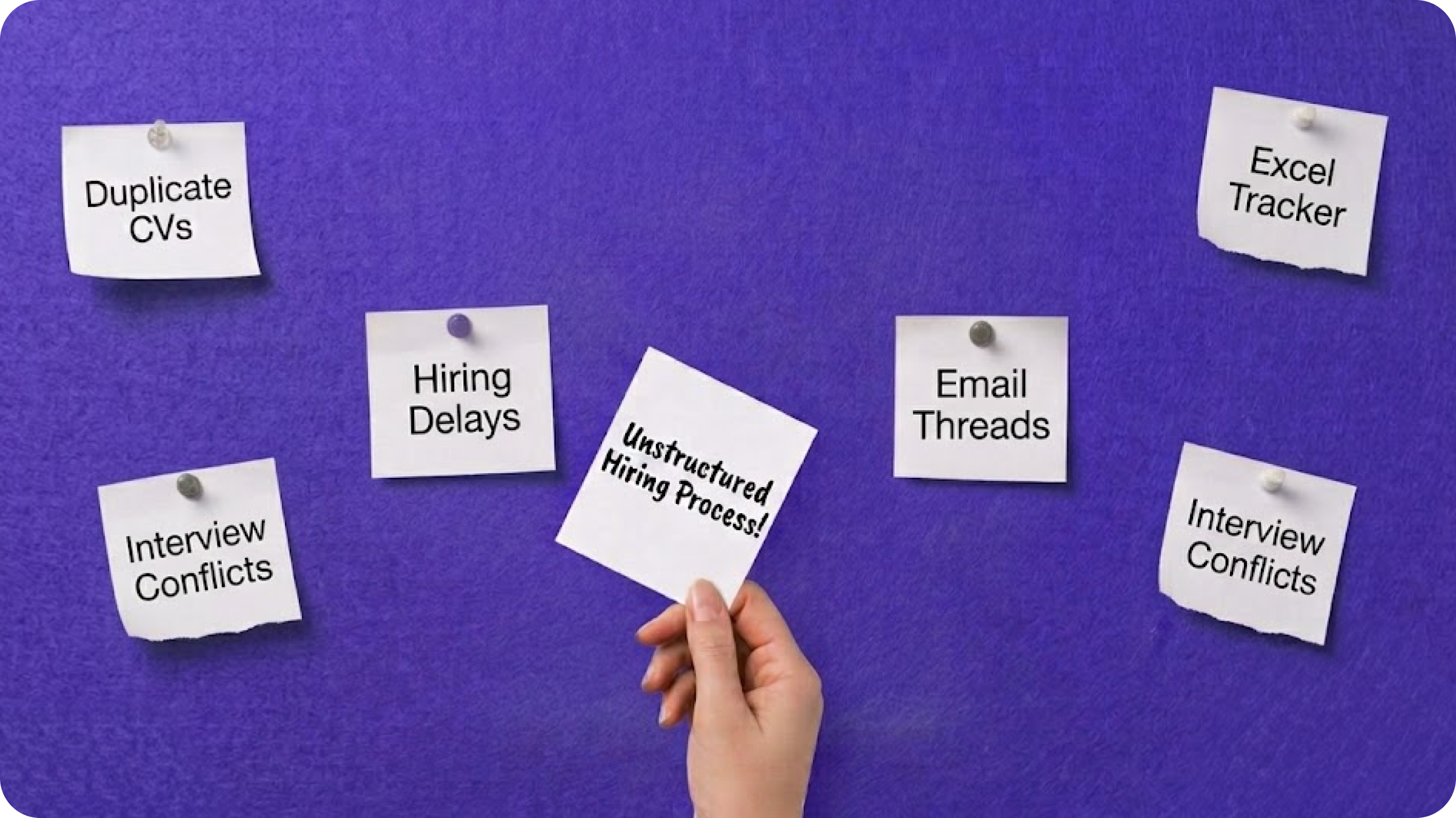
Unstructured recruitment doesn't mean chaotic. Most companies that run unstructured processes think they are managing fine. They have a system it just happens to be built from email threads, Excel trackers, shared folders, and a lot of manual follow-up.
This works at low hiring volumes. At 5 or 10 hires a year, the overhead is manageable. But most growing companies are not hiring at that pace. They are hiring across multiple roles, multiple departments, multiple locations and doing it through 3, 5, or 8 recruitment vendors simultaneously.
At that scale, unstructured recruitment starts generating hidden costs across every stage of the hiring process.
Where the hidden costs actually live
1. Coordinator time
Every unstructured recruitment process has someone usually an HR executive or TA coordinator whose job is effectively to be the system. They chase vendors. They compile updates. They send reminders. They reconcile candidate lists at the end of the week.
This work is invisible because it is absorbed into someone's existing role. But if you tracked the hours, you would find that a significant portion of your HR team's week is spent on coordination rather than actual hiring decisions.
A conservative estimate: if one coordinator spends 8 hours a week on vendor management overhead at a cost of ₹40,000/month, that is ₹4,800 per week ₹19,200 per month being spent purely on coordination that a structured system would eliminate or reduce significantly.
2. Duplicate candidate processing
In an unstructured multi-vendor process, duplicate CVs are inevitable. Two vendors submit the same candidate. Nobody knows who found them first. The hiring manager reviews the same profile twice. HR has to investigate ownership. The vendor relationship gets strained.
Each duplicate submission costs time reviewing a CV you have already seen, investigating ownership, managing the conflict. Across 50 positions a year with 5 vendors each, this adds up to dozens of hours of wasted effort annually.
Beyond the time cost, duplicate submissions create vendor disputes. And vendor disputes damage relationships sometimes permanently. Losing a strong vendor because of a badly handled duplicate incident is a real cost that nobody tracks.
3. Delayed closures
Hiring delay is one of the most expensive things that can happen to a growing company and most of it is not caused by a shortage of candidates. It is caused by a shortage of coordination.
When a vendor submits a candidate and nobody acknowledges it for three days, the candidate moves on. When an interview gets scheduled through email and the confirmation gets buried, the interview does not happen. When there is no clear status on a position, vendors assume it is deprioritised and stop working on it.
Each of these delays extends the time-to-hire. And time-to-hire has a direct business cost. A revenue-generating role that stays vacant for an extra three weeks is three weeks of lost productivity. A customer-facing role that goes unfilled because the process was slow is three weeks of potential revenue impact.
Most companies have no way to see how much of their hiring delay is caused by process gaps versus candidate supply because they have no system tracking it.
4. Vendor performance drift
In an unstructured process, you have no real-time visibility into which vendor is performing. You find out at the end of the quarter when you look back at who placed candidates by which point months of opportunity have already been lost.
The result is that your strongest vendors and your weakest vendors get treated almost identically. They get the same job requirements. They get followed up with at the same frequency. There is no mechanism to reward performance with more work or to redirect roles away from vendors who are not delivering.
This means you are consistently leaving performance on the table. If you could identify your top-performing vendor and give them 30% more roles you would close faster, spend less on coordination, and build a stronger vendor relationship. Most companies cannot do this because they have no live data to base the decision on.
5. Billing disputes and delayed payments
At the end of a hire, someone has to figure out which vendor placed the candidate, what the agreed fee was, and when payment is due. In an unstructured process, this often involves going back through email chains to reconstruct a timeline.
Billing disputes slow down payments. Slow payments damage vendor relationships. And vendors who have not been paid on time are less motivated to prioritise your roles next month.
This creates a cycle that compounds over time slower payments leading to weaker vendor relationships leading to slower hiring leading to more coordinator time spent on follow-up.
What structured looks like
A structured recruitment process does not mean a complicated one. It means:
- Every job requirement goes to vendors through one system, not individual emails
- Every candidate submission comes back through the same system, timestamped and de-duplicated
- Every status update interview scheduled, feedback given, offer made is visible to everyone who needs to see it
- Vendor performance data is live, not compiled manually at the end of each month
- Billing is clean because the submission record is unambiguous
When this structure exists, the hidden costs start to disappear. Coordinator time drops because the system handles the chasing. Duplicate submissions get flagged automatically. Hiring timelines shorten because there are no coordination gaps. Vendor relationships improve because communication is consistent and payments are clean.
Putting a number on it
Every company's hidden recruitment costs are different. But as a rough framework:
If you are hiring 30+ positions a year through 3 or more vendors, and your process is primarily managed through email and Excel, you are likely spending:
- 15-20 hours per month on coordination overhead
- 5-10% longer on average time-to-hire due to process gaps
- 2-4 billing disputes per quarter due to unclear submission records
These are conservative estimates. For many companies the actual numbers are higher.
The question is not whether these costs exist. It is whether you are measuring them.
The first step is visibility
You cannot fix what you cannot see. Most companies running unstructured recruitment processes have no way to quantify the overhead because the overhead is distributed across people's time and buried in email threads.
The first step is not to buy a platform. The first step is to measure what your current process is actually costing you in hours, in delayed closures, in vendor relationship quality.
Once you have that number, the decision about whether to move to a structured system becomes straightforward.
Highring was built to remove these hidden costs
Highring is India's recruitment vendor management platform built specifically for companies hiring through multiple vendors who want to replace coordination overhead with a structured system.
If you are managing 3 or more vendors and still running your process through email and Excel, it is worth a conversation.